

Syro-Malabar Church
Overview
The Syro-Malabar Catholic Church is one of the 23 Eastern (Oriental) Catholic Churches in full communion with Rome. It is the largest Eastern Catholic Church and also the largest of the Saint Thomas Christian (Nazrani) denominations with 5.2 million believers (according to the latest statistics as is found in the Syro-Malabar Church Year Book 2020, p. 51). It is a sui juris Church governed by the Synod of Bishops headed by the Major Archbishop. The Syro-Malabar Church, with its deep-rooted spirituality, Christian life, parish activities, youth ministry, ecclesiastical, charitable, health and educational institutions, publications and involvement in social activities and high rate of vocations to priesthood and religious life is the most active, living, vibrant and the rapidly growing Catholic community in the world.
The St. Thomas Christians (Nazranis)
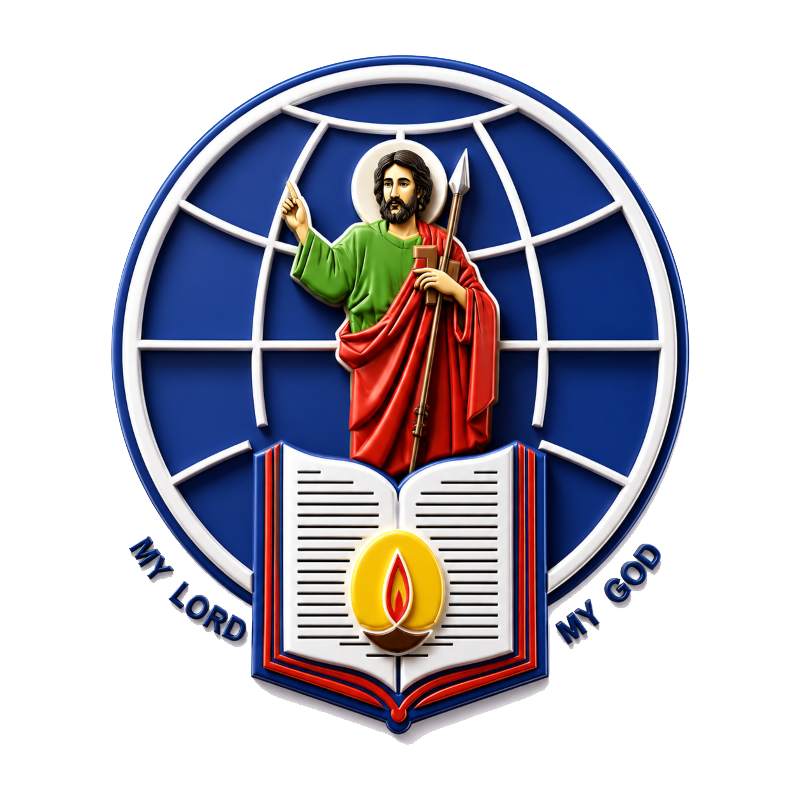
The Syro-Malabar Church is an Apostolic Church which traces its origin to the St. Thomas, the Apostle, who landed at Kodungalloor (Muziris) in 52 AD and founded seven Christian communities in Kerala, at Palayur, Kodungalloor, Kokkamangalam, Paravur, Kollam, Niranam and Nilakkal. St. Thomas was martyred in 72 AD at Mylapore, in Chennai/Madras. The early Christian community in India was known as St. Thomas Christians. They were also called Nazranis, meaning those who follow the path of Jesus of Nazareth.
The East Syrian (Chaldean) Connection
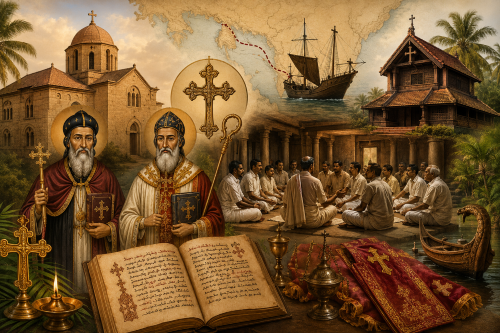
From early centuries, the Church of St. Thomas Christians came into contact with the East Syrian Church (Church of the East), which also traces its origin to Apostle Thomas. From the 4th century until the end of the 16th century St. Thomas Christians were governed by bishops who were appointed and sent by the Patriarch of the East Syrian Church. The Thomas Christians developed a unique system of ecclesiastical administ-ration with the bishops from Persia in charge of liturgical and spiritual matters and the local Archdeacon of All India (A priest) heading the Christian community and handling the administration of the Church through Palliyogam (early form of Synod). Thus the Thomas Christians shared the THE SYRO-MALABAR CHURCHAN OVERVIEW liturgical, theological, spiritual and other ecclesiastical traditions with the East Syrian Church; in socio-cultural organization, rites and ceremonies and customs and practices, however, they were distinctively Indian.
The Arrival of Portuguese and the Influence of the Latin Church
The arrival of the Portuguese in the 16th century marks a new era in the life of the Thomas Christians. With the introduction of Padroado rule (the Portuguese ecclesiastical jurisdiction in India) East Syrian Bishops stopped coming. Archdeacon lost his position and Latin Prelates exercised full authority over ecclesiastical administration for almost three centuries. This paved way for the latinization of liturgy and ecclesiastical administration. Following the Coonan Cross oath of 1653 Propaganda jurisdiction directly under Rome too started functioning in Kerala in 1661 which resulted in the division of the Thomas Christians into two groups, of which the group which resisted Latin rule formed a separate community under the Archdeacon which later accepted the West Syrian theological and liturgical tradition of the West Syrian Orthodox Church of Antioch and came to be known as the Jacobite Church. They were further divided into several independent Churches. The group that remained faithful to Rome came to be known as Syro-Malabar Church, a name which became a common epithet only in the nineteenth century which literally means Syrian Christians of the Malabar Coast (Kerala).
The Syro-Malabar Church
In 1886 the Portuguese Padroado jurisdiction over the whole Malabar (Kerala) was suppressed and in 1887 Pope Leo XIII re-organized the Syro-Malabar Catholics into two independent Vicariates of Kottayam and Trichur. Finally, the Syro-Malabar Church obtained bishops of their own rites and nationality in 1896, when they were further reorganized into three vicariates of Trichur, Changanacherry and Ernakulam by Pope Leo XIII through his Brief Quae rei Sacrae. Later, the Syro-Malabar Hierarchy was established on 21 December 1923 with the Apostolic Constitution Romani Pontifices of Pope Pius XI (Acta Apostolicae Sedis, 16 [1924], pp. 257-262), with Ernakulam as the Metropolitan See and Trichur, Changanacherry and Kottayam (established in 1911 for the Southists) as suffragans. In 1956 Changanacherry was raised to the status of a Metropolitan See. The restoration of the hierarchy initiated a process of liturgical reform that sought to restore the oriental identity of the Latinized Syro-Malabar rite, which was approved by Pius XII in 1957 and introduced in 1962. In subsequent years several new dioceses were established both within and outside Kerala. From 1962, the Church began to set up mission territories in Northern India, which later became dioceses. The subsequent years witnessed a steady growth of this Church both in India and outside.
The Syro-Malabar Major Archiepiscopal Church
On 16 December 1992 Pope John Paul II with the Apostolic Constitution Quae maiori (Acta Apostolicae Sedis, 85[1993], pp. 398-399) raised the Syro-Malabar Church to the status of Major Archiepiscopal sui iuris Church with the title of ErnakulamAngamaly. Mar Antony Padiyara, the then Metropolitan of Ernakulam was appointed its first Major Archbishop and Mar Abraham Kattumana as the Pontifical Delegate who discharged the duties of the Major Archbishop. Archbishop Kattumana died unexpectedly during his visit to Rome in April 1995 and Mar Padiyara was given the powers of the Major Archbishop; however, assisted by Mar James Pazhayattil of the diocese of Irinjalakuda. In November 1996 Cardinal Padiyara resigned from his office as Major Archbishop. In his place Archbishop Varkey Vithayathil, C.Ss.R. was appointed as the Apostolic Administrator. In December 1998 he was appointed Major Archbishop by the Pope. In February 2001 Archbishop Varkey Vithayathil was created a cardinal by Pope John Paul II. In 2004, the Holy See granted full administrative powers to the Syro-Malabar Church, including the power to elect bishops. Major Archbishop Cardinal Varkey Vithayathil passed away on April 1, 2011. On 24 May 2011 Mar George Alencherry was elected Major Archbishop. Pope Benedict XVI confirmed the election on 25 May 2011. He is the first head of the Syro-Malabar Church to be elected by its Synod. On February 18, 2012 Major Archbishop George Alencherry was made cardinal and a member of the Roman Consistory. On 10 October 2017 with the erection of the eparchies of Shamshabad and Hosur and the extension of territories of Thuckalay and Ramanathapuram, the Syro-Malabar Church was given jurisdiction for pastoral care and evangelization all over India.
The Syro-Malabar Church Today
Of the 23 individual Churches which constitutes the Catholic communion the SyroMalabar Church is the largest Eastern Church in Catholic communion. The other two Catholic Churches in India are the Latin Church and the Syro-Malankara Church. In the Syro-Malabar Church at present there are 35 archdioceses and dioceses. The five archdioceses are Ernakulam-Angamaly, Changanacherry, Trichur, Tellicherry and Kottayam and 13 eparchies within the canonical territory of the Major Archi-episcopal Church are Bhadravathi, Belthangady, Irinjalakuda, Kanjirapally, Kothamangalam, Idukki, Mananthavady, Mandya, Palai, Palghat, Ramanathaapuram, Thamarassery, and Thuckalay and 13 eparchies outside, of which Adilabad, Bijnor, Chanda, Gorakhpur, Jagdalpur, Rajkot, Sagar, Satna, and Ujjain in India are with exclusive jurisdiction and Kalyan, Faridabad, Shamshabad and Hosur in India and the St. Thomas Eparchy of Chicago in the United States of America, Eparchy of St. Thomas the Apostle of Melbourne, St. Thomas the Apostle Eparchy of Great Britain and the St. Thomas the Apostle eparchy of Missisauga in Canada also enjoy personal jurisdiction. In Europe and New Zealand Syro Malabar Church has apostolic visitators. There are altogether 46,33,242 Syro-Malabarians within the 35 Syro-Malabar Eparchies and 5,74,373 members live as migrants outside SyroMalabar Eparchies. Thus there are altogether 52,07,615 Syro-Malabar faithful around the globe. There are 65 Bishops including 19 emiriti (besides 25 bishops serving in the Latin dioceses and 4 archbishops in Vatican diplomatic service), 4558 diocesan priests, 5484 men religious and 32,465 women religious and 1230 major seminarians (in 17 Major seminaries). Many bishops, priests, religious and laity of the Syro-Malabar Church are present all over the world and share in the missionary and pastoral life of the sister Churches. The Syro-Malabar Church is very actively involved in educational, social and health-related fields. The Syro-Malabar Church runs 5009 educational, 282 ecclesiastical and 3115 health and charitable institutions. The corporate contribution of the Syro-Malabar Church to nation-building is inestimable. This Church which has today 4 Saints, 2 Blesseds, 4 Venerables and 14 Servants of God is heading all other Churches in living the Christian faith, eastern tradition and missionary zeal.
A Glance of the Significant dates of the History of Syro-Malabar Church
St. Thomas, the Apostle, landed at Cranganore (Kodungalloor)
Martyrdom of St. Thomas at Mylapore, Chennai.
: Pantaenus of Alexandria visited the Christians of St. Thomas in India
Mar Yohannan from India participated in the first Ecumenical Council of Nicea.
Thoma of Kinayi from Persia landed at Cranganore with 72 families
Ayyanadikal, the King of Venad, granted privileges and 72 stately positions to the Church and to the St. Thomas Christians by the “Tharisapalli copper plates”.
King Alfred of England sent his representative to the tomb of St. Thomas the Apostle at Mylapore.
By the Order of “Thazhekad Sasanam” the leaders of the Syrian Christians are granted special privileges.
Marco Polo, a Venetian traveler, visited the tomb of St. Thomas at Mylapore.
Portuguese sailor Vasco da Gama landed in Kerala
With the Portuguese sailor Cabral 7 Franciscan missionaries reached Kerala
Portuguese excavated the tomb of St. Thomas at Mylapore.
St. Francis Xavier came to Kerala
Metropolitan Mar Abraham transferred residence from Cranganore to Angamaly.
Mar Abraham, the last Chaldean bishop, died and was laid to rest at St. Hormis Chuch, Angamaly.
The Synod of Diamper held by Archbishop Alexis de Menezes.
Francis Roz SJ becomes the first Latin bishop of Angamaly for the St. Thomas Christians.
Angamaly is raised an archdiocese with the archbishop’s residence at Cranganore.
The Metropolitan of Goa limits the Pastoral Jurisdiction enjoyed by the St. Thomas Christian bishops all over the India, setting the boundary from the South to the North of Malabar.
In protest against the Portuguese rule of the Church, the Marthoma Christians pledge the “Coonan Cross Oath” at Mattancherry, Cochin.
At Alangad 12 priests placed their hands upon Archdeacon Thoma to consecrate him bishop and the division among the St. Thomas Christian community.
The Vicariate of Malabar is erected by Pope Alexander VII.
Beginning of Propaganda Jurisdiction in Kerala.
Consecration of Mar Chandy Parampil as the Vicar Apostolic of Malabar
Mar Gregorios, the first Jacobite bishop came to Malabar.
A seminary started for the Syrians at Verapoly.
Bishop Mar Chandy Parampil died.
Bishop Joseph Sebastiani became Vicar Apostolic of Malabar.
St. Thomas Christians came under double jurisdictions: The Propaganda represented by the Carmelite Vicar Apostolic of Verapoly and the Padroado represented by the Archbishop of Kodungalloor.
Vicariate of Malabar is suppressed and the Vicariate of Verapoly is erected by Pope Clement XI.
Historic journey of Fr. Joseph Kariattil and Fr. Thomas Paremmakkal to Rome and Lisbon.
Mar Joseph Kariattil was elected the Archbishop of Cranganore; consecrated in Lisbon in 1783.
1786 : Mar Joseph Kariattil died in Goa.
Paremakkal Thoma Kathanar (Governador) died
St. Thomas Christians came under the Archdiocese of Verapoly.
St. Kuriakose Elias Chavara was appointed the Vicar General of the St. Thomas Christians.
Bishop Rocos sent by the Patriarch of Chaldea reached Kerala (Rocos Schism).
Bishop Mar Elias Melus reached Kerala (Melus Schism).
1886 The Archdiocese of Crangannore is suppressed.
Establishment of the Syro-Malabar Apostolic Vicariates of Kottayam and Trichur by the Bull “Quod Jam Pridem” of Pope Leo XIII. The St. Thomas Christians are separated from the jurisdiction of the Archbishop of Verapoly and from the Padroado.
Vicariates of Kottayam and Trichur were reorganized into Vicariates of Changanacherry, Ernakulam and Trichur
Pope Pius X created the Vicariate of Kottayam for the Southists of the Syro-Malabar Rite.
Establishment of the Syro-Malabar Hierarchy with Ernakulam as the Metropolitan see and Trichur, Changanacherry and Kottayam as sufragan Sees.
Reunion of the eminent Jacobite Archbishop Mar Ivanios, Bishop Mar Theophilus, Fr. John O.I.C., Bro. Alexander and Mr. Chacko Kilieth into the Catholic Church.
Puthenpally seminary is shifted to Aluva
: Jubilee Celebration of St. Thomas and St. Francis Xavier at Ernakulam.
Pius XII appoints a commission to revise the Syro-Malabar liturgical texts
The territory of Syro-Malabar Church is extended beyond Pampa in the south and Bharathapuzha in north to the whole of Kerala and to the territories of the Latin dioceses of Mangalore, Chickmangalur, Mysore and Coimbatore.
St. Thomas Apostolic Seminary Vadavathoor, Kottayam was started.
Malayalam translation of Syro-Malabar Qurbana introduced.
Archbishop Joseph Parecattil was installed as the first Cardinal of the Syro-Malabar Church.
Beatification of Fr. Kuriakose Elias Chavara and Sr. Alphonsa by Pope John Paul II at Kottayam.
H. B. Mar Antony Padiyara became Cardinal.
Code of Canons of the Eastern Churches (CCEO) promulgated. 1992 Sep 4 : Pontifical Commission of Rome came to study the problems of SyroMalabar Church, visited all the Syro-Malabar dioceses.
Pope John Paul II raised the Syro-Malabar Church to a Major Archiepiscopal Sui Juris Church with the constitution “Quae Majori”. Archbishop Antony Cardinal Padiyara was appointed first Major Archbishop. Archbishop Abraham Kattumana was made the Pontifical Delegate with powers of the Major Archbishop.
The first Synod of the Syro-Malabar Church.
Archbishop Abraham Kattumana, the Pontifical Delegate, died in Rome.
Syro-Malabar Synod in Rome.
Installation of Mar Varkey Vithayathil CSsR, Apostolic Administrator to the Syro-Malabar Church.
Inauguration and blessing of the Major Archiepiscopal Curia at Mount St. Thomas, Kakkanad.
The first session of the Major Archiepiscopal Assembly was inaugurated at Mount St. Thomas, Kakkanad.
Investiture of Mar Varkey Vithayathil CSsR as the second Major Archbishop of the Syro-Malabar Church.
H.B. Antony Cardinal Padiyara, the first Major Archbishop was called to eternal life.
Beatification of Sr. Mariam Thresia by Pope John Paul II.
Major Archbishop Mar Varkey Vithayathil CSsR was created Cardinal by Pope John Paul II. 2001 Jun : Good Shepherd Major Seminary at Kunnoth was started.
Conclusion of the celebration of 1950th Anniversary of the Entrance of St. Thomas the Apostle and 450th Death Anniversary of St. Francis Xavier by CBCI at Ernakulam.
Decree revoking the reservation to elect bishops.
Beatification of Fr. Kunjachan Thevarparampil by Pope Benedict XVI. 2006 Dec 3 : Beatification of Sr. Euphrasia by Pope Benedict XVI.
Canonization of St. Alphonsa by Pope Benedict XVI.
Demise of the Major Archbishop Mar Varkey Cardinal Vithayathil CSsR.
The Syro-Malabar Bishops’ Synod elects Mar George Alencherry the Major Archbishop.
The installation ceremony of Mar George Alencherry at St. Mary’s Basilica, Ernakulam.
Mar George Alencherry is raised to the status of Cardinal by Pope Benedict XVI.
Canonization of St. Kuriakose Elias Chavara and St. Euphrasia Eluvathingal by Pope Francis.
Syro-Malabar Church receives all-India jurisdiction with the inauguration of Shamshabad Diocese.
The “Ad Limina Apostolorum” visit of the Syro – Malabar Bishops
Inauguration and Blessing of DOMUS MAR THOMA, the Syro Malabar Procura in Rome
Canonization of St. Mariam Thresia by Pope Francis